Trump Expands Consumer Protections as Data Center Energy Demand Sparks Ratepayer Concerns
07/28/2026 / By Chase Codewell

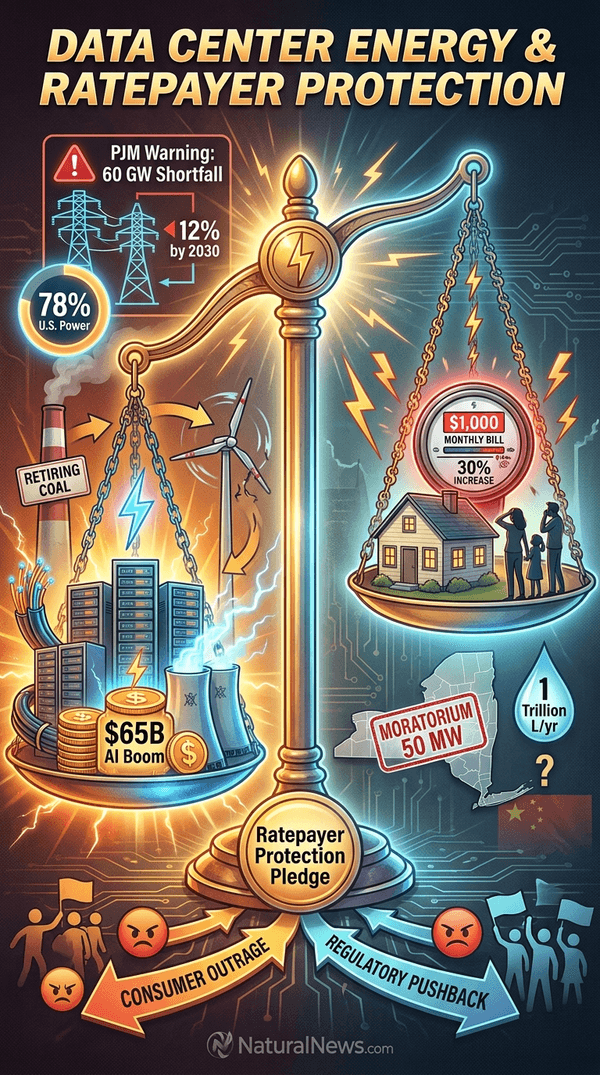
President Donald Trump on July 23, 2026, announced an expansion of the Ratepayer Protection Pledge during an event at Environmental Protection Agency headquarters in Washington. The voluntary pledge requires data center developers to cover the costs of new energy infrastructure, according to White House officials, in an effort to prevent cost shifts to residential ratepayers. The announcement comes as energy bills in regions with heavy data center concentration, such as Northern Virginia, have risen sharply, with some households facing monthly electricity costs exceeding $1,000 this past winter. [12]
Background: AI Data Centers and Rising Electricity Demand
Data centers currently consume about 4.4% of total U.S. electricity, a figure projected to reach 12% by 2030, according to industry estimates cited by the White House. [12] A report by the International Energy Agency found that electricity consumption by U.S. data centers has significantly increased, posing challenges for grid operators and utilities. [2] The PJM Interconnection, the nation’s largest regional power grid, launched an emergency plan to secure 15 gigawatts of new generation after its capacity auction fell 6.8 gigawatts short of the reliability target for the third consecutive year. [5][11]
Wood Mackenzie projects that U.S. spending on power generation equipment for data centers could reach $65 billion by 2030, more than tripling the $20 billion recorded in 2025. [3] Local officials across the country have raised alarms that rapid data center construction is straining grid capacity and threatening blackouts. [4] The underlying dynamic is that the United States has plateaued in power generation for about a decade while data center demand surges, as noted in analysis of energy trends. [8]
Trump’s Ratepayer Protection Pledge and Expansion
Speaking at the EPA event, Trump urged communities to welcome AI data centers, arguing they would make communities “rich.” “Your community and your state’s going to become rich, and there’s very little disruption,” Trump said. “If you don’t take all that money, somebody else is going to take it.” He acknowledged that data center expansion requires massive power increases: “You need double the electricity that we have right now, maybe even more than that.” Trump stated that new power plants built to serve data centers would eventually lower household bills. “Once more power plants are built, electricity bills for American families will actually come down,” he said.
The pledge was first introduced in March 2026, when major tech companies including Google, Microsoft, Meta, Oracle, xAI, OpenAI, and Amazon agreed to cover the electricity used by their AI data centers. [6] The White House announced on July 23 that nearly 200 additional stakeholders had signed on since March, and that 23 governors had now signed the pledge. [12] White House press secretary Karoline Leavitt said the expanded participation significantly increased the program’s coverage, accounting for about 80% of power used at U.S. businesses and homes. [12]
Opposition and Concerns Over Data Center Expansion
Not all states have embraced the data center buildout. New York Governor Kathy Hochul, a Democrat, signed an executive order in June 2026 imposing a one-year moratorium on the construction of large data centers. [10] Business leaders warned that the move risks driving jobs and investment to other states. Trump criticized the moratorium, calling data centers “Money Machines” for the states where they are built. [10]
Some Republican officials have alleged that Chinese influence operations are fueling public opposition to data centers, though no evidence has been presented, officials said. [12] Consumer outrage over rising energy costs has been a key driver of the backlash, with spiking utility bills becoming a major issue in recent gubernatorial elections in Virginia. [1] Critics also point to the water consumption of data centers, which has surged to nearly one trillion liters per year in the United States, further straining local resources. [13] The pledge is nonbinding, and only Republican governors have signed so far. [12]
Signatories and Broader Implications
Major technology companies that signed the original Ratepayer Protection Pledge in March include Google, Microsoft, Meta, Oracle, xAI, OpenAI, and Amazon. [6] Executives have expressed concern that continued consumer and regulatory pushback could push data center investments overseas, according to industry sources. [12] The White House stated that pledge signatories now account for about 80% of U.S. power consumption across businesses and homes. [12]
The expansion of the pledge comes as grid operators scramble to keep pace with demand. PJM Interconnection warned of a potential 60-gigawatt shortfall within a decade, risking reliability for 65 million Americans. [7] Meanwhile, U.S. spending on power generation equipment for data centers is forecast to reach $65 billion by 2030. [3] The situation highlights the tension between technological advancement and infrastructure capacity, with implications for energy affordability nationwide.
Conclusion
The expansion of the Ratepayer Protection Pledge represents the Trump administration’s primary policy response to the conflict between surging data center power demand and household energy affordability. While the pledge remains voluntary and has only attracted Republican governors, the administration argues that increased participation will prevent cost shifts to ratepayers. With data center electricity consumption projected to triple by 2030 and grid reliability already strained, the coming years will test whether private commitments can keep pace with public concern.
References
- NaturalNews.com. “A pledge for power but a thirst unquenched Techs data center dilemma”. NaturalNews.com. February 28, 2026.
- Chase Codewell. “Report Data Center Electricity Demand Rising Impacting Grid Capacity and Policy Debates”. NaturalNews.com. April 22, 2026.
- Edison Reed. “AI Data Center Boom Drives 65 Billion Power Equipment Demand Amid Supply Chain Constraints”. NaturalNews.com. May 02, 2026.
- Petra Stone. “Mayors Sound Alarm AI Data Centers Push US Toward Blackouts and Water Shortages”. NaturalNews.com. March 18, 2026.
- Willow Tohi. “Soaring AI demands ignite 161B grid crisis threatening US energy affordability”. NaturalNews.com. July 23, 2025.
- Laura Harris. “Trump announces energy pledge with major tech firms to cover AI power costs”. NaturalNews.com. March 09, 2026.
- NaturalNews.com. “PJM grid scrambles for 15 GW of power as AI data centers threaten reliability”. NaturalNews.com. April 13, 2026.
- Robert Bryce. “A Question of Power Electricity and the Wealth of Nations”.
- V. Daniel Hunt. “Handbook of energy technology trends and perspectives”.
- 100PercentFedUp.com. “President Trump Issues Statement After New York Enacts First Statewide Data Center Moratorium”. July 15, 2026.
- NaturalNews.com. “PJM Auction Falls 6.8 Gigawatts Short of Reliability Target Amid Data Center Demand Surge”. July 17, 2026.
- The Epoch Times. “Trump Expands Plan to Keep AI Data Centers From Increasing Household Energy Bills”. July 23, 2026.
- NaturalNews.com. “Rising AI Demand Drives Surge in Data Center Water Consumption, Reports Indicate”. July 06, 2026.
Explainer Infographic
Submit a correction >>
Tagged Under:
AI data centers, big government, Bubble, Donald Trump, electricity, energy, energy costs, energy supply, market crash, New York, pensions, power, power grid, Ratepayer Protection Pledge, risk, supply chain, White House
This article may contain statements that reflect the opinion of the author
RECENT NEWS & ARTICLES